

The short answer: save the tooth if it can be saved
If your natural tooth can be repaired and restored, a root canal is often the first choice. If the tooth is too damaged to save, an implant is a strong way to replace it. The American Association of Endodontists, the root canal specialists, says the same: saving a natural tooth is often preferred when it can be restored to full function.
So the choice is not really one against the other. It starts with a question: can this tooth be saved? Your dentist answers that with an exam and X-rays.
What a root canal does
A root canal treats the inside of a tooth. When the soft center, called the pulp, gets infected or badly irritated, the dentist cleans it out, seals the space and then covers the tooth with a crown. Your tooth stays in place with its own root and ligament.
The AAE says keeping the natural tooth is generally less invasive, costs less and takes fewer appointments than an implant. A root canal is done under numbing, and many people say it feels about like getting a filling.
Cost and convenience matter, but so does how you feel about your own teeth. Many people value keeping their natural tooth, with its own root and its feel when they chew. Others would rather deal with a problem tooth once and move on. Both views are fair.
Whichever you pick, a plan for the long term matters. Ask what care the tooth or implant will need over the next ten years, such as a night guard, a new crown or more frequent cleanings. A good answer today saves surprises later.
What an implant does
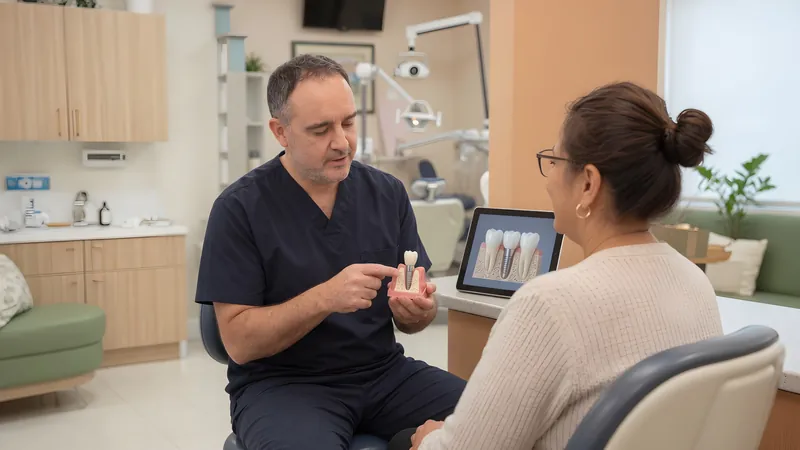
An implant replaces a tooth that is gone or has to come out. A titanium post goes into your jaw and acts as a new root. A crown goes on top once the bone has fused to the post. Cleveland Clinic says that takes about three to nine months.
That means surgery and a longer timeline than a root canal. The upside is that an implant can be a lasting fix for a tooth that cannot be saved, with no risk of decay in the implant itself. It also does not rely on the teeth next to it, as a bridge does.
When a root canal makes sense
A root canal is often the better path when:
- There is enough healthy tooth above the gum to hold a crown
- The root is not cracked below the gum line
- The bone around the tooth is still in good shape
- The infection is inside the tooth and can be cleaned out
- You want to keep your natural tooth and avoid surgery
When an implant makes sense, including a cracked tooth
An implant is often the better path when:
The tooth has a crack that runs down into the root; The tooth is broken so far below the gum that a crown cannot hold on; A root canal has already failed once and the problem returned; Gum disease has destroyed much of the bone that holds the tooth; The tooth is already gone.
Cracked teeth are a common reason for this choice, and the answer depends on where the crack goes. A small crack in the crown of the tooth can often be fixed with a filling or a crown. A crack that runs down into the root usually means the tooth cannot be saved, and an implant becomes the better plan.
Pain when you bite and let go, a sharp zing with cold and a tooth that hurts for no clear reason are all clues. They are not proof. Your dentist uses a bite test, special lights, X-rays and sometimes a 3D scan to find the line.
Comparing long-term results
Both treatments work well when they are done for the right tooth. The AAE says that research has found similar success for both. One older study that the AAE cites found that implants needed follow-up treatment or surgery more often: 12.4% for implants compared with 1.3% for teeth that had root canal treatment. Dentists who place implants have disagreed with how that study was done.
What does that mean for you? Implants are reliable, and they are not maintenance-free. Root canal-treated teeth, too, need a good crown and good cleaning to last. Neither one is a guarantee.
Free X-ray, exam and consultation. New Patient Special. New patients only.
The patient and any other person responsible for payment has the right to refuse to pay, cancel payment or be reimbursed for payment for any other service, examination or treatment that is performed as a result of and within 72 hours of responding to any advertisement for the free, discounted fee or reduced fee service, examination or treatment. D0191, C6182
Time, cost, comfort and making the choice
In general, a root canal with a crown takes fewer visits and fewer months. An implant takes time for healing, and may need a bone graft or an extraction first.
On cost, the AAE says saving the natural tooth is generally less expensive. The final price depends on the tooth, your plan and any extra steps, so ask for a written estimate that includes the crown. Insurance often treats these two treatments differently, so ask the office to check your benefits.
On comfort, both are done with numbing. Soreness after a root canal usually fades in a few days. After an implant, soreness and swelling usually fade in about a week, according to Cleveland Clinic.
This choice should feel clear, not rushed. If you are in pain, a dentist can calm the tooth now and talk about the long-term plan after. If you are unsure, it is fine to ask for a second look.
Think about your goals. Some people want the fewest visits. Some want to keep every natural tooth. Some want a result that they can forget about. None is wrong. The best plan is the one that fits your tooth, your health and your life, and that you understand.
How to decide, and where to start at KDA
Ask your dentist these questions: Can this tooth be saved? What are the odds? What would a crown need? What would an implant plan look like? What are the time and the cost of each? What happens if the first choice does not work?
At KDA, we offer both root canal therapy and implants, so the advice is not tilted toward one. We take a 3D scan in our office when we plan an implant, and Dr. Alfredo Calderon has over 15 years of experience in implants. If you have a toothache that will not quit, call right away. We provide emergency care 24/7.
Call 305-271-1421. We are at 8833 SW 107th Ave in Kendall, open Monday to Friday, 8:00 AM to 5:00 PM. New patients can ask about a free implant evaluation. We accept most dental insurances and most Medicare supplemental plans, and financing is available.
Common questions
Is a root canal or an implant better?
Neither is better for every tooth. Saving the natural tooth is often preferred when it can be restored. An implant is a strong option when it cannot.
Which costs more, a root canal or an implant?
The AAE says saving the natural tooth is generally less expensive. Your exact costs depend on the tooth and your plan.
Can a tooth with a root canal still need an implant later?
Yes, if the tooth cracks or the infection returns. Regular exams help catch it.
Does a root canal hurt?
The tooth is numbed, and many people say it feels about like a filling. Some soreness for a few days is common.
How do I know if my tooth can be saved?
Your dentist checks with an exam and X-rays. Cracks, decay below the gum and bone loss are what they look for.
This article is general information, not medical advice. Your dentist will confirm what is right for you at your exam. General information checked against: aae.org, my.clevelandclinic.org, mouthhealthy.org.