

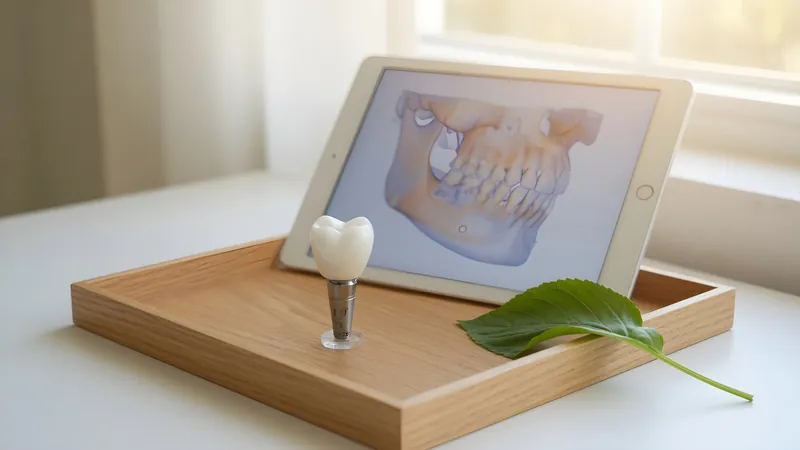
What a dental implant is
A dental implant replaces a missing tooth, root and all. A small post goes into your jawbone and works like a root. Your new tooth sits on top.
An implant has three parts:
- The implant: a small post with threads, usually titanium (a strong metal). It is the new root.
- The abutment: a small connector that comes up through the gum
- The restoration: the part you see. It can be a crown (a tooth cap), a bridge or a denture.
Step 1: An exam and a plan in 3D
First, your dentist checks your mouth, your health and your medicines. Then we take a 3D scan, called CBCT, in our office.
A normal X-ray is flat. A CBCT scan shows your jawbone in 3D. It shows how much bone you have. It also shows the nerves and sinuses (air spaces). Then your dentist plans the size, angle and spot of each implant.
If your bone is too thin, a bone graft can add bone first. We tell you if you need one. We take digital scans of your teeth, so there is no messy tray of goop.
Step 2: Placing the implant
On implant day, we numb the area. Your dentist uses a surgical guide made from your 3D scan. It places the implant in the exact spot and angle we planned. Then the gum is closed around it.
Some soreness and swelling after is normal. Cleveland Clinic says it usually gets better in about a week. Store-bought pain relievers can help. Eat soft, cool or lukewarm foods the first days.
Step 3: Healing while the bone grows
This step matters most. Over the next months, your jawbone grows around the implant and locks it in place. Dentists call this osseointegration. Cleveland Clinic says it takes about three to nine months. It depends on your bone and your health.
You do not have to go without teeth. Often you can wear a temporary tooth, bridge or denture while you heal. In some cases, you can even get new teeth the same day.
Step 4: Your new tooth
When the implant is firm, we attach the abutment and scan for your final tooth. We make it to match the shape and color of your other teeth. Then we put it in and adjust your bite until it feels right.
Brush, floss and get checkups like you would for a natural tooth. With good care, the implant can last a lifetime. The crown on top may need replacing someday, like any crown.
Free X-ray, exam and consultation. New Patient Special. New patients only.
The patient and any other person responsible for payment has the right to refuse to pay, cancel payment or be reimbursed for payment for any other service, examination or treatment that is performed as a result of and within 72 hours of responding to any advertisement for the free, discounted fee or reduced fee service, examination or treatment. D0191, C6182
Who can get an implant
Health matters more than age. Many people in their 60s and 70s get implants. Your dentist looks at:
- Your general health, and how well diabetes or other long-term problems are controlled
- Your gums. They should be healthy, or treated first.
- Your jawbone. It must be thick enough, or built up with a graft.
- Smoking and vaping. Both slow healing.
Who does your implant at KDA
Dr. Alfredo Calderon and Dr. David Faget lead implant care at our office. Dr. Calderon has over 15 years of implant experience. He places implants and makes the teeth that go on top. Both steps happen here.
Before you decide, the doctor explains each step, the timing and any risks. New patients can call 305-271-1421 for a free implant evaluation.
Common questions
Does getting an implant hurt?
We numb the area first. Some soreness and swelling after is normal. It usually gets better in about a week.
How long does the whole process take?
It depends on your case. Healing usually takes three to nine months. We give you a timeline after your 3D scan.
How much do implants cost?
Implants start at $99 a month. You get your exact plan and cost after the exam. Financing is available.
This article is general information, not medical advice. Your dentist will confirm what is right for you at your exam. General information checked against: my.clevelandclinic.org, mouthhealthy.org.