

The short answer: decades, with good care
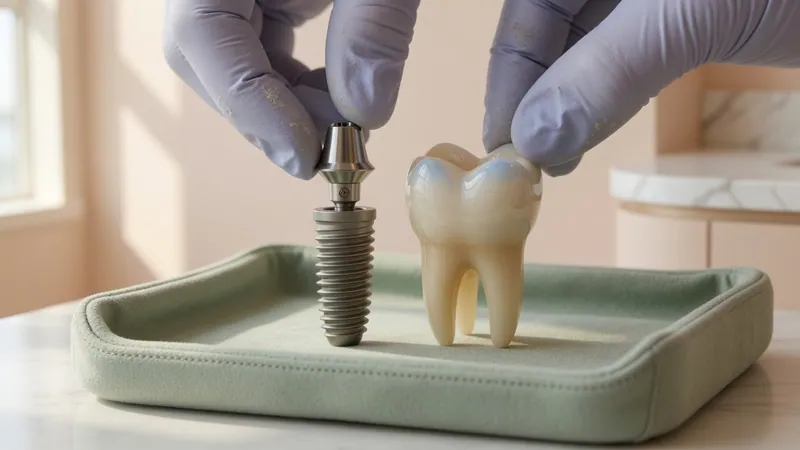
A dental implant can last for decades, and for many people it lasts a lifetime. The titanium post that sits in your jawbone is built to stay. The crown on top usually wears out sooner and may need to be replaced.
Dentists talk about two numbers. Survival means the implant is still in your mouth. Success means it is still healthy, with no bone loss or infection. Survival numbers are always a bit higher, so it helps to ask which one you are hearing.
What the research shows
Long studies are the best way to answer this question. One large clinical study of 511 implants in 303 patients followed them for ten years. It found a 98.8% survival rate and a 97% success rate. Gum infection around the implant showed up in only 1.8% of implants over those ten years.
Other studies report lower numbers, often in the low-to-mid 90s at ten years. Why the gap? Studies use different rules for what counts as a success. They also follow different groups of people. A study of healthy patients with good gum health will look better than one that includes heavy smokers or people with uncontrolled diabetes.
The honest takeaway: most implants placed in healthy mouths are still working ten years later. No one can promise a number for your own mouth, but your dentist can tell you what raises or lowers your odds.
Implant post vs. crown: two different clocks
An implant has parts that age differently. Think of it like a house and its paint.
The post is the foundation. Once your jawbone has grown around it, it is very stable. It does not decay, because it is not a tooth.
The crown is the paint. It takes the daily wear of chewing, grinding and the occasional bite on something hard. Cleveland Clinic notes that most crowns and bridges last around 15 years. Some last longer. Some need a repair or a new crown sooner, especially if you grind your teeth at night.
A replacement crown is a much smaller job than a new implant. We often keep the same post and only make a new tooth to fit on it.
Implants vs. other options, and what age changes
Implants tend to outlast the other common ways to replace a tooth, and the reason is simple: the post sits in bone. Bone that is used to chewing stays stronger. When a tooth is lost and nothing replaces the root, the bone in that spot slowly shrinks. An implant gives the bone a job to do again.
Cleveland Clinic says most crowns and bridges last around 15 years, and most dentures last at least seven years. Bridges also rely on the teeth next to the gap, which have to be shaped to hold the bridge. If one of those teeth has trouble later, the whole bridge can fail. A single implant stands on its own and leaves the neighbors alone.
That does not mean an implant is the right pick for everyone. It takes surgery, healing time and a healthy mouth. Dentures and bridges can be good answers, and your dentist should explain the trade-offs in plain words. We cover that choice in more detail in our guide to implants, bridges and dentures.
Age by itself is not the problem. Many people in their 60s, 70s and 80s have implants that work well. What matters more is your health and how well you can keep the area clean.
As we get older, a few things can change. Some medicines dry out the mouth, and a dry mouth is harder on gums and crowns. Arthritis can make brushing and flossing harder. Some people have a harder time keeping their appointments. All of these have simple fixes: a softer brush with a bigger handle, a water flosser, a rinse for dry mouth, or a reminder call.
If you already have an implant and your health changes, tell your dentist. A new medicine, a new diagnosis such as diabetes, or a change in your smoking habits can all affect how you should care for the implant. A quick update helps us protect it.
What helps your implant last
Most of the control is in your hands. These habits make the biggest difference:
- Brush twice a day and clean between the teeth every day. Plaque can inflame the gum around an implant just like it does around a natural tooth.
- Keep your checkups. We look at the gum, the bite and the bone on your X-rays, and we catch small problems early.
- Wear a night guard if you grind or clench your teeth. Grinding is hard on crowns.
- Skip chewing ice, hard candy or pen caps.
- Keep health conditions like diabetes under control, and keep up with your gum care.
What shortens an implant's life
The main threat is gum infection around the implant, called peri-implantitis. It starts as red, puffy or bleeding gums. If it is not treated, it can eat away the bone that holds the implant. It is much easier to treat early.
Smoking is the other big one. A large review pooled 35,511 implants in smokers and 114,597 in non-smokers. Failures happened in about 6.4% of the smokers' implants and about 3.3% of the non-smokers'. The review found smokers had roughly 2.4 times the odds of failure. Vaping can also slow healing, according to Cleveland Clinic.
Poorly controlled diabetes, untreated gum disease and heavy teeth grinding also raise the risk. None of these are a reason to give up on an implant. They are reasons to plan carefully and treat the problem first.
Free X-ray, exam and consultation. New Patient Special. New patients only.
The patient and any other person responsible for payment has the right to refuse to pay, cancel payment or be reimbursed for payment for any other service, examination or treatment that is performed as a result of and within 72 hours of responding to any advertisement for the free, discounted fee or reduced fee service, examination or treatment. D0191, C6182
Signs it is time to call your dentist
Do not wait for your next cleaning if you notice any of these:
- Bleeding, swelling or pus around the implant
- A bad taste or bad breath that does not go away
- An implant or crown that feels loose or wobbly
- Pain when you chew
- Gums that are pulling back from the implant
Planning an implant that lasts at KDA
Long life starts with a good plan. At KDA we take a 3D scan (CBCT) in our office to see your bone before we place an implant. A surgical guide made from that scan helps place the implant in the planned spot and angle. Dr. Alfredo Calderon has over 15 years of experience with implants, both the surgery and the teeth that go on top.
We will go over your health, your gums and your habits, and tell you honestly what to expect. New patients can call 305-271-1421 about a free implant evaluation. Our office is at 8833 SW 107th Ave in Kendall, open Monday to Friday, 8:00 AM to 5:00 PM. We accept most dental insurances and most Medicare supplemental plans, and financing is available.
Common questions
Do dental implants last forever?
Many last a lifetime, but no one can guarantee it. The post often lasts decades. The crown on top wears and may need replacing.
How long does the crown on an implant last?
Cleveland Clinic says most crowns and bridges last around 15 years. Grinding your teeth can shorten that, so a night guard helps.
Can an old implant be saved if the gum gets infected?
Often, yes, if it is caught early. Treatment can clean the area and calm the gum. Call us at the first sign of bleeding or swelling.
Do implants need special cleaning?
They need the same daily care as natural teeth: brushing, cleaning between the teeth and regular checkups. Your dentist may suggest tools that fit your mouth.
Does smoking shorten the life of an implant?
Yes. A large review found smokers had about 2.4 times the odds of implant failure. Quitting helps your odds.
This article is general information, not medical advice. Your dentist will confirm what is right for you at your exam. General information checked against: my.clevelandclinic.org, mouthhealthy.org, dentistryiq.com, pmc.ncbi.nlm.nih.gov.