

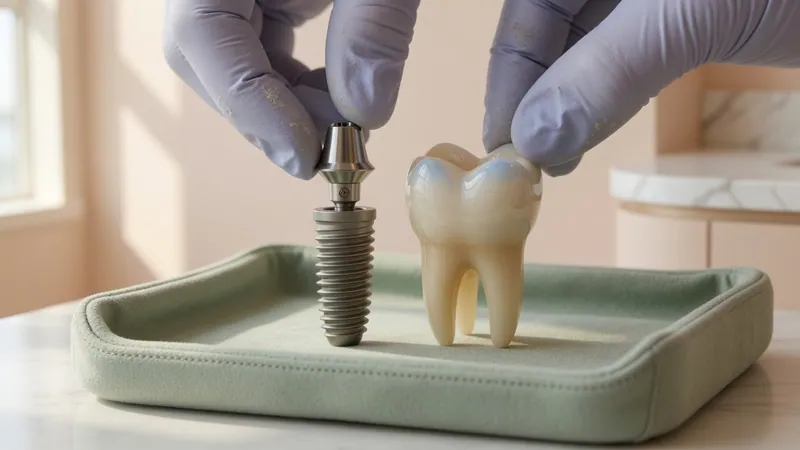
The short answer: look for experience, planning and follow-up
A good implant dentist has years of experience placing and restoring implants, plans each case with a 3D scan and stays with you after the surgery. Ask to see how they plan, who does each step and what happens if something goes wrong.
Implants are an investment in your health and your smile, so it pays to compare. The American Dental Association suggests talking to more than one dentist before you decide. You do not need to rush. A good office will welcome your questions and give you time to think.
This guide gives you the numbers and the questions to compare offices fairly.
Take your time with the answer. Unlike a cleaning, an implant plan has many steps and takes months. The dentist you pick will be part of your life for a while, and for years after through checkups.
What the success numbers really say
Implants have strong results. Cleveland Clinic reports that its head and neck specialists had a 95 percent success rate for implant integration (the bone growing around the implant) in 2023, with 10 of 216 implants showing early failure. It adds that 95 percent is the commonly reported international average.
Long-term numbers are a bit lower, and they are worth knowing. A large study of 10,871 implants in 4,247 patients, reported by the Royal College of Dental Surgeons of Ontario, found survival of 96.7 percent at 5 years, 92.5 percent at 10 years and 86 percent at 15 years. At 10 years, single implants did better than cases with multiple implants (98.2 percent vs. 90.2 percent).
Two takeaways. First, implants usually last, but they are not guaranteed. Second, results depend on the patient and the dentist. Gum health, diabetes, smoking and teeth grinding can all affect the outcome, and so does the planning and skill of the person doing the work.
Keep the difference between "success" and "survival" in mind. Survival means the implant is still in your mouth. Success usually means it is healthy and working without problems. Many studies report survival, so ask your dentist how they measure results in their own office.
Who does the surgery and who makes the tooth?
An implant has two jobs. One person places the post in the bone. Another makes the crown, bridge or denture that sits on top. In some offices, one dentist does both. In others, you are sent to a specialist for surgery and back to your dentist for the tooth.
Neither way is wrong. Just ask. When the same team plans, places and restores your implant, there are fewer handoffs and less chance for a message to get lost. If the work is split, ask how the two offices talk to each other.
Also ask how long the dentist has been placing implants. Experience matters. Ask how many they do each year and what kinds of cases they handle, from a single tooth to a full arch.
It is also fair to ask about the dentist's training. Look for continuing education in implants, courses taken after dental school, and years of hands-on practice. Teaching roles and professional memberships can also show a dentist who keeps learning.
Check for 3D planning and surgical guides
A flat X-ray cannot show how thick your bone is, or where the nerves and sinuses sit. A CBCT scan is a 3D X-ray that can. Ask whether the office takes it on site, and whether the dentist uses it to plan the implant before any surgery.
A surgical guide is another good sign. It is a custom plastic template made from your scan, and it helps the dentist place the implant in the planned spot and angle. It does not replace skill, but it adds accuracy.
Ask whether digital scans are used for your impressions. A small camera scanner is more comfortable than the old trays of putty, and it often gives a better fit.
If the office does not have a 3D scanner, ask where the scan is done and how the information gets back to the dentist. It should not stop you from going there, but the plan will depend on a clear handoff.
Questions to ask before you say yes
Bring this list to your consultation:
It is good to ask these in writing as well, by email after your visit, so you have the answers in front of you when you compare. Ask for the same answers from each office.
- How many implants have you placed, and for how many years?
- Will you or a specialist place the implant? Who makes the final tooth?
- Do you use a 3D scan and a surgical guide for my case?
- Am I a good candidate? Will I need a bone graft or gum treatment first?
- What is the full timeline, and will I have a temporary tooth?
- What is the full cost, including the scan, surgery, abutment (the connector), crown and follow-up?
- What are the risks, and what happens if the implant fails?
- How will you care for my implant over the long run?
Watch for red flags
Be careful with offices that give you a price without examining you, or that promise results with no risk. No dentist can guarantee an implant. Be careful, too, with anyone who pushes you to sign on the spot, or who cannot explain a plan in simple words.
A real treatment plan is written. It lists each step, the timeline and the cost. It also tells you what could change the plan, like a bone graft you did not expect.
Check how the office handles problems. Ask what the follow-up schedule looks like and whom to call if something feels wrong after surgery. Implants need care for years, so you want a team that will be there.
Beware of the "too good to be true" offer. Real implant care takes planning, healing time and skilled work. If a deal skips the exam or the scan, ask why.
Cost and payment: ask for the whole picture
Implants cost more up front than some other options, but they are built to last. When you compare prices, check what each one includes. A low price for the post alone is not the same as a price for the post, the abutment and the crown.
Ask about insurance, because some plans cover part of the work, and about financing, because monthly payments can make a big treatment easier to manage. Compare the options side by side, including bridges and dentures, so you can choose with your eyes open.
Ask what happens if you need a repair later. Crowns can wear out like any crown, and parts can loosen. A good office tells you what is covered, what is not and how fast they can see you.
Implants at Kendall Dental Associates
Dr. Alfredo Calderon has over 15 years of experience in both the prosthetic and surgical sides of implants, and he trained at Tufts University School of Dental Medicine. We take 3D CBCT scans in our office, use them to plan your case and make surgical guides from the measurements. We also use an intraoral scanner for digital impressions, so there is no gagging on impression material.
We have served Kendall since 1973, at 8833 SW 107th Ave. Call 305-271-1421 for a free implant evaluation. Financing is available, and we accept most dental insurances.
Free X-ray, exam and consultation. New Patient Special. New patients only.
The patient and any other person responsible for payment has the right to refuse to pay, cancel payment or be reimbursed for payment for any other service, examination or treatment that is performed as a result of and within 72 hours of responding to any advertisement for the free, discounted fee or reduced fee service, examination or treatment. D0191, C6182
At your free evaluation, the doctor will go over your health, your gums and your bone, and explain your options. You can also ask about replacing several teeth or a whole arch. We explain each step, the timing and the risks, and we never push you to decide on the spot.
Common questions
How successful are dental implants?
Cleveland Clinic reports about 95 percent integration success. A large study found 92.5 percent survival at 10 years. Results depend on your health and your dentist.
Should a specialist place my implant?
Not always. General dentists with implant training and experience can place them. Ask about experience and about the cases they handle.
What is a surgical guide?
A custom template made from your 3D scan that helps place the implant in the planned spot and angle.
Do I need a bone graft?
Maybe. If your jawbone is too thin, a graft can add bone first. A 3D scan shows whether you need one.
How much does an implant cost?
It depends on your case. Ask for a written plan that lists scan, surgery, connector, crown and follow-up. Financing may be available.
This article is general information, not medical advice. Your dentist will confirm what is right for you at your exam. General information checked against: my.clevelandclinic.org, rcdso.org, mouthhealthy.org.