

The short answer
A CBCT scan is a 3D X-ray of your teeth, jaw bones, nerves and sinuses. CBCT stands for cone beam computed tomography. A machine circles your head for under a minute and takes many images that a computer combines into a 3D picture.
A regular dental X-ray is flat. A CBCT scan lets your dentist see depth, so they can see where things are in all three directions. It is a tool used when a flat picture is not enough.
Most dental visits do not need a CBCT scan. Your dentist uses a regular X-ray to check for cavities and gum health, and that is enough for most people. A CBCT scan is for the cases where the flat picture leaves a question open.
The name sounds technical, but the idea is simple. It is a better map. Just as a map app shows more than a paper sketch, a 3D scan shows more than a flat X-ray, and a better map helps your dentist plan a safer route.
How a CBCT scan works
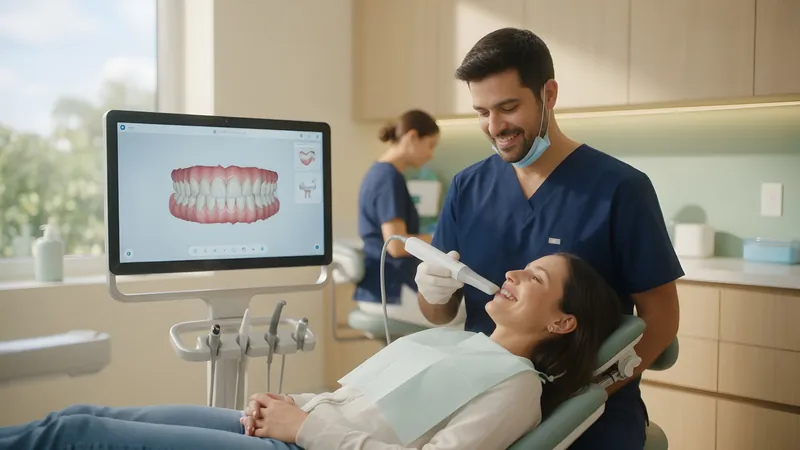
You stand or sit still while a small arm rotates around your head. The machine sends a cone-shaped beam and captures images from many angles. Software builds a 3D model that your dentist can turn, slice and measure on a screen.
The scan is painless and noninvasive. You do not need to bite on anything uncomfortable, and nothing goes in your mouth. You will usually be asked to remove glasses, earrings or other metal, and to hold still for the scan, which takes less than a minute.
The 3D picture is made of tiny cubes of data, which software stacks up. Your dentist can slice through the picture from front to back or side to side, almost like paging through a book, to look at one spot at a time.
Because the machine is so fast, there is little time to move. If you have trouble staying still, say so before the scan. Staff can help you get comfortable and, in some cases, use a quicker setting.
What a CBCT scan can show
A 3D picture helps your dentist see things a flat X-ray can hide:
Your dentist can show you the scan on the screen and point out what they see. Seeing your own jaw in 3D is also a good way to understand why a treatment plan makes sense.
- How tall, wide and dense your jawbone is
- Where the nerves and sinuses are
- Hidden extra canals or infection around the root of a tooth
- The position of impacted teeth, such as wisdom teeth
- Jaw joint problems
- Hidden causes of pain that do not show on a flat X-ray
The most common use: planning dental implants, and other uses
CBCT is a key tool for implants. Before placing one, your dentist needs to know how much bone you have, how dense it is and where the nerves and sinuses sit. A flat X-ray cannot show that.
At Kendall Dental Associates, we take CBCT 3D images in the office and use them to plan implants. We also make surgical guides from the CBCT measurements, so the implant goes in at the planned spot and angle. You can read more about the full process in our guide to how dental implants work.
CBCT is also used for other situations, such as:
- A root canal on a tricky tooth, when the roots are hard to see
- Finding the exact position of an impacted tooth before it is removed
- Checking a bone problem or cyst
- Looking at the jaw joint
- Planning more complex tooth movement or oral surgery
How is it different from a regular X-ray?
A regular dental X-ray, like a bitewing, takes a quick, small, flat picture. It is great for finding cavities between teeth and checking bone levels. It is the right tool for most routine visits.
A CBCT scan covers a bigger area and gives a 3D view. It uses more radiation than a single regular X-ray, which is why it is used when your dentist needs the extra detail, not as a routine check.
Each tool has a job. Think of a regular X-ray as a snapshot, and a CBCT scan as a video you can walk around in. You would not make a video to check a small spot, but for a complex plan the extra view matters.
Is CBCT safe?
CBCT uses X-rays, so there is radiation. The dose depends on the machine, the size of the area scanned and the settings, and it varies a lot. In general, a CBCT dose is higher than a single regular dental X-ray, and many studies find it is lower than a medical CT scan of the same area.
The ADA says dental imaging should be used in moderation, and that your dentist should take X-rays only when they are likely to give useful information. Dentists follow a rule called ALARA, which stands for as low as reasonably achievable. It means using the smallest dose and area that give the answer.
Tell your dentist if you are pregnant or think you might be. They will weigh the need for the scan with you.
One more point is that more detail is not always better. If a regular X-ray answers the question, your dentist should use it. A good office will tell you why they want a scan, what area it covers and how it changes the plan.
What to ask before a scan
It is fair to ask:
- Why do I need this scan, and what will it change?
- Can a regular X-ray answer the same question?
- What area will be scanned?
- Will you share the pictures with me?
- Can you show me what you see?
3D scans at KDA
Kendall Dental Associates offers 3D scans and digital radiographs, which use less radiation than traditional film X-rays. Your dentist will explain why a scan helps before it is taken and show you the results in plain words.
New patients can ask about our New Patient Special: FREE X-Ray, Exam & Consultation (New Patients Only). Call 305-271-1421 or visit 8833 SW 107th Ave, Miami, in the Kendall Mall. We are open Monday to Friday, 8:00 AM to 5:00 PM, with emergency care available 24/7. We accept most dental insurances and most Medicare supplemental plans, and financing is available.
Our team can also share your images with a specialist when you need a referral, so you do not repeat a scan. Ask us for a copy of your images if you want one.
Common questions
Is a CBCT scan the same as a CT scan?
They are related. A dental CBCT scan uses a cone-shaped beam and a smaller machine, usually for the teeth and jaw. A medical CT scans larger body areas.
Does a CBCT scan hurt?
No. You hold still for under a minute while the machine moves around your head.
Do I need a CBCT scan for a dental implant?
Often, yes. It shows bone and nerves in 3D, which helps your dentist plan where the implant goes.
How much radiation is in a CBCT scan?
It varies with the machine and the area scanned. It is generally higher than one regular dental X-ray, so dentists use it only when needed.
Can I get a CBCT scan while pregnant?
Tell your dentist if you are or might be pregnant. They will usually delay a scan that is not urgent.
This article is general information, not medical advice. Your dentist will confirm what is right for you at your exam. General information checked against: ada.org, adanews.ada.org, mouthhealthy.org.